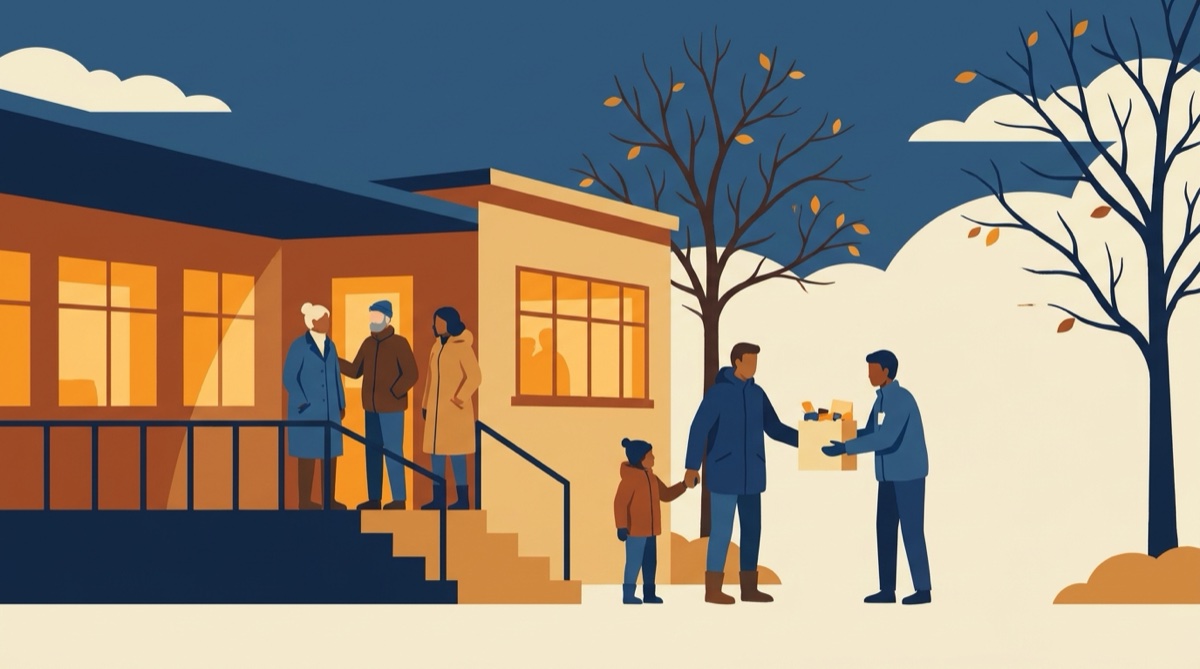
What if House of Friendship didn’t exist?
As the year comes to a close and you consider which charities to donate to, I’d like to make the case for why you should donate to House of Friendship.
Imagine Waterloo Region without them.
Not the easy version of that thought — the missing logo on a website. The harder one. The quiet absences. The family that never meets a worker who speaks their language. The fridge that stays empty at the end of the month. The man who never gets a bed with healthcare and addiction support under the same roof. The crisis that could have been interrupted at a community centre and instead has years to dig in.
House of Friendship has been doing this work since 1939. It started as a storefront mission in downtown Kitchener — a women’s prayer group feeding hungry men — and grew into one of the most consequential social-service organizations in this region. Nearly nine decades later they still walk with people who need food, housing, addiction treatment, and neighbourhood support. Their latest community reporting puts roughly 350 staff across more than forty locations. Their homepage says they help more than 42,000 people a year. In 2025 they put about 41,700 food hampers into Kitchener–Waterloo homes, supported roughly 1,900 people through addiction treatment, and — through ShelterCare, their emergency shelter in Waterloo with wraparound health and recovery supports — helped 31 men find housing. Friendship Village, their new supportive-housing community downtown, is set to open later this year for about a hundred residents recovering from homelessness.
Those are the visible numbers. They matter. They are also not the whole story.
The part that is easiest to miss — and the part that would hurt most if it disappeared — is the early work. House of Friendship’s Family Outreach Program exists to prevent and reduce the effects of poverty for families with children seventeen and under. Workers meet people in their own neighbourhoods. They problem-solve basic needs together. They connect families to services. When necessary, they provide direct support. Current program materials describe that work plainly: walk with families, find solutions, do not leave them alone with the paperwork and the panic.
You can see what that looks like in their published stories. A newcomer mother arrives in Waterloo with almost nothing in a rented house. A Community Development Worker speaks with her in Arabic. A Family Outreach Worker helps her get beds, a sofa, a kitchen table — the difference between sleeping on the floor and starting a life. Another community member living on Ontario Works leans on neighbourhood food programs week after week so rent does not force an empty fridge. Holiday food last December reached 6,200 households. Family Outreach Workers supported nearly two thousand families across dozens of neighbourhoods. Six community centres across Kitchener and Waterloo run programs, food distribution, after-school supports, and the kind of ordinary belonging that never makes a headline.
That is the invisible architecture.
Now run the reverse. Remove it.
A rent shortfall that could have been steadied with timely help can become housing instability. Food stress that could have been interrupted at a neighbourhood hamper can become the kind of grinding scarcity that wears people down. Isolation that could have been met with a trusted worker and a community centre can deepen into something much harder to climb out of. I am not claiming a neat formula — poverty in, addiction and homelessness out, every time. Life is messier than that. But you do not need a randomized trial to understand compounding. When an early problem cannot be solved close to home, the risk grows that it becomes a later crisis: addiction, homelessness, family breakdown, a tangle of issues that demand far more than a grocery card and a conversation. ShelterCare and live-in treatment exist because some people already need that intensity. The quieter gift of House of Friendship is how often they meet people before that point — and how seriously they take the work after it too.
Losing an organization of this calibre would not only remove beds and hampers. It would remove relationships that took years to earn. It would remove a continuum that runs from a neighbourhood food program to addiction counselling to a pathway out of homelessness. Institutions like this compound in the best sense: eighty-seven years of showing up creates trust, skill, and capacity you cannot improvise in a budget cycle.
So when I imagine Waterloo Region without House of Friendship, I do not start with the press release. I start with the kid whose parent never got that first piece of help. The man who never walked into a shelter that treated his health as part of the job, and never found his way back to hope. The family that never heard, in their own language, that they did not have to face it alone.
If you are choosing where a year-end gift goes, put them at the top of the list. A donation sustains the preventative work and the visible rescue work — the community-centre conversation and the ShelterCare bed, the food hamper and the treatment program. Donate online, by phone at 519-742-8327 x 131, or by mail to their Victoria Street office. Receipts start at ten dollars. They are a registered Canadian charity.
The impacts you cannot see are exactly why they deserve the credit — and the support.